
How To Get Financially Fit in Your 30s and 40s
If you’re looking for ways to get financially fit in your 30s and 40s, we will explore some practical ways. Financial security brings peace of mind, and personal finance looks different for everyone; we can implement benchmark strategies to build financial freedom in our 30s and 40s.
How to Get Financially Fit if You Are in Your 30s
We already shared how much money you need saved by your 30s, but if you’re trying to sort out your finances so you can benefit from it in retirement, we will outline the exact steps to get there.
Most people make money and save what’s left after they pay all their bills. Some of us were told at some points in our lives that investing is for rich people. Some of us also aren’t sure which stocks are right to invest in.
The truth is, investing will help you compound more money over time if done right. The myth: investing requires thousands. You can start investing with as little as $100. You don’t need to wait until you’re making more, and you don’t need to become rich to start investing.
In fact, many of the wealthiest people you see today invest their money in real estate, stocks, bonds, and mutual funds.
How to Get Financially Fit in Your 30s
Your 30s are the years you spend building, whether it’s building out a retirement plan, building your real estate portfolio, or building your investment portfolio. It is at this stage that we identify what we lack and how we will build towards it.
Our 30s aren’t about confusion about what we want anymore. We know that having a steady flow of income requires some kind of investment or asset.
In order to get financially fit in your 30s, you need to break old habits first. These are things you’ve done in your 20s that will cause you to delay becoming rich in your 30s. If you were attached to always buying the latest trends, buying impulsively, or saying yes to every offer, those habits and behaviours will keep you stuck.
Once you train your brain and become disciplined about where your money is going, investing will become easier for you to adopt.
Ways To Get Financially Fit in Your 30s
If you really want to start controlling your financial situation in your 30s, get yourself financially literate. And I’m not just talking about understanding the budgeting rule 50/30/20. Get to know different types of stocks worth investing in, annuity plans, and real estate investing. Take time to plan an emergency fund. Your emergency fund should have at least 6 months of your living expenses. Learn about ways to invest in real estate without having money, the best dividend-paying stocks, and savings apps that give you interest on your money.
Particularly, get to know the best high-yield savings accounts. These are information will help you maximise the return on your investments.
In your 30s, you need to be conscientious about the use of your credit card and cards that will give you rewards. Getting your credit in check is also important as you build in your 30s.
Look for opportunities and people that align with your skills. Building connections with the right people can open doors that lead to wealth.
When you’re 30, invest at least 15% of your total annual income. Your savings in your 30s should be about $50,000. If you earn less than $100k a year, you’ll need a second job or side hustle to invest more. If you earn over $100,000 a year, you can start investing aggressively for 5-10 years to get financially fit.
How to Get Financially Fit in Your 40s
Your 40s can be one of the most important decades of your financial life. By this stage, you’ve probably spent years working, paying bills, supporting your family, and making financial decisions that have shaped where you are today. But have you ever stopped to ask yourself whether you’re financially prepared for the next 10 or 20 years?
If you’re wondering how to get financially fit in your 40s, the good news is that you still have time to make meaningful changes that can improve your financial future.
Being financially fit isn’t necessarily about earning a six-figure salary, owning a large home, or having hundreds of thousands of dollars sitting in your bank account. It’s about understanding your finances, managing your money wisely, reducing unnecessary debt, and making decisions that support your long-term financial goals.
For some people, turning 40 means finally earning a comfortable income. For others, it means realizing they haven’t saved enough for retirement, still have credit card debt, or are struggling to balance everyday expenses with their future financial needs.
Whatever your financial situation looks like, your 40s offer an opportunity to reassess your priorities and create a realistic plan for building wealth.
Why Financial Fitness Matters in Your 40s
One of the biggest reasons financial planning becomes increasingly important in your 40s is that retirement is getting closer.
If you plan to retire at 65, turning 40 means you have approximately 25 years to save, invest, and build the financial security you’ll need when you stop working.
While 25 years might seem like a long time, the financial decisions you make today can significantly influence how comfortably you live in retirement.
For example, investing $500 every month for 25 years could grow to approximately $405,000, assuming a hypothetical 7% annual return compounded monthly. That’s $150,000 in contributions, with the remaining amount coming from investment growth. Actual returns will vary, and taxes, fees, and inflation can reduce the value of your savings.
This demonstrates why consistent investing can be such a powerful wealth-building strategy, even if you’re getting started later than you originally planned.
However, becoming financially fit involves more than investing.
It also means building an emergency fund, managing your household expenses, reviewing your insurance coverage, increasing your earning potential, and avoiding financial mistakes that could interfere with your long-term goals.
You might also be navigating additional responsibilities, such as raising children, paying a mortgage, supporting aging parents, or preparing to fund your children’s education.
These responsibilities make having a clear financial plan even more important.
The key is to focus on progress rather than comparing your financial situation with someone else’s.
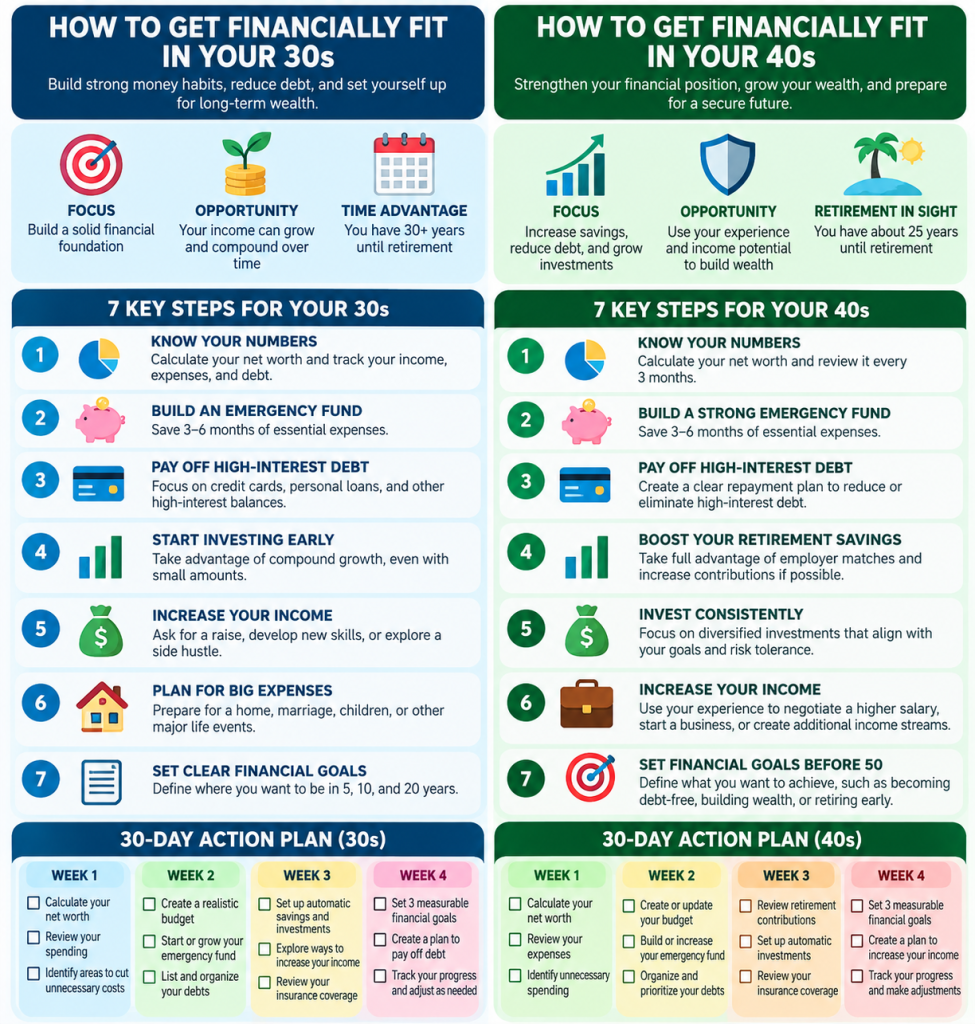
Use this infographic to help you create the best financially fit plan for you if you are in your 30s or 40s.